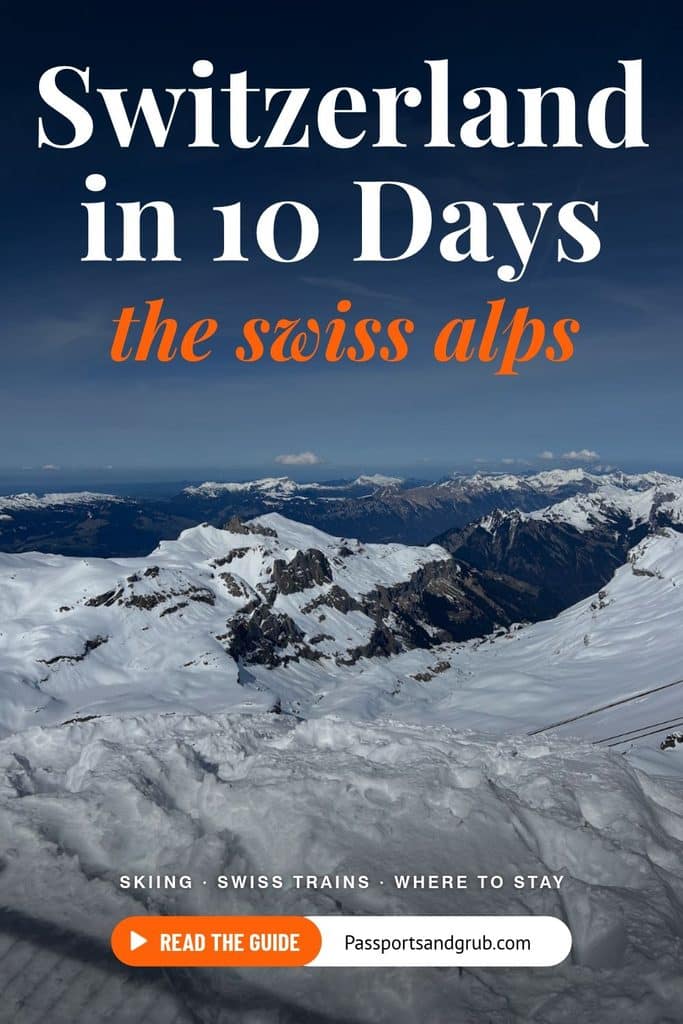
Your Ultimate Ten-Day Switzerland Itinerary Guide
Updated: November 2, 2026 | By Tomiko Harvey
If the Swiss Alps are on your bucket list, you are in the right place. I visited Switzerland with my girlfriends, and we spent hours on trains watching snow-dusted peaks roll past the window.
We moved between Geneva, Bern, Interlaken, and the mountains, then finished with eight hours on the Glacier Express and a few quiet nights at the 7132 Hotel in Vals.
So here is my answer, straight up.
The best 10-day Switzerland itinerary starts in Zurich and ends in Geneva, moving east to west by train so you never backtrack.
Spend two nights in Zurich, two in Lucerne, three in Interlaken or Grindelwald, one in Lausanne, and one in Geneva, then fly home from Geneva.
Most 10-day itineraries zigzag. Switzerland is small, but every backtrack costs you two or three hours on a train you already rode.
The route I took moves in one direction, east to west, so your days go to mountains and lakes instead of transfers.
For getting around, I would buy the 8-day Swiss Travel Pass and activate it on Day 3, when you leave Zurich.
The links in this post may be affiliate links. That means that if you click them and make a purchase, this site makes a commission. It will have no impact on the price you pay or the experience of your purchase.
The cost is CHF 439 (about $542) in second class, and it covers nearly every train, bus, and lake boat on this route, plus free or discounted rides up mountains like Rigi, Pilatus, Titlis, and Jungfraujoch.
If this is your first trip or if you are traveling with friends or a partner, and you want to explore cities, lakes, and the Alps without renting a car, this is the route I suggest.
Your 10-Day Switzerland Itinerary at a Glance
| Day | Base | Highlights |
|---|---|---|
| 1 | Zurich | Old Town, Grossmünster, Lindenhof, Sprüngli |
| 2 | Zurich | Rhine Falls, Swiss National Museum, Uetliberg |
| 3 | Lucerne | Chapel Bridge, Lion Monument, Pilatus or Rigi |
| 4 | Lucerne | Mount Titlis, or a slow lake day |
| 5 | Interlaken | Harder Kulm, Lake Brienz, Giessbach Falls |
| 6 | Interlaken | Jungfraujoch or Grindelwald First |
| 7 | Interlaken or Mürren | Mürren, Gimmelwald, Schilthorn |
| 8 | Lausanne | Bern stop, Lavaux vineyards, Chillon Castle |
| 9 | Geneva | Old Town walking tour, Red Cross Museum, Carouge |
| 10 | Geneva | Fly home, or add the Glacier Express |
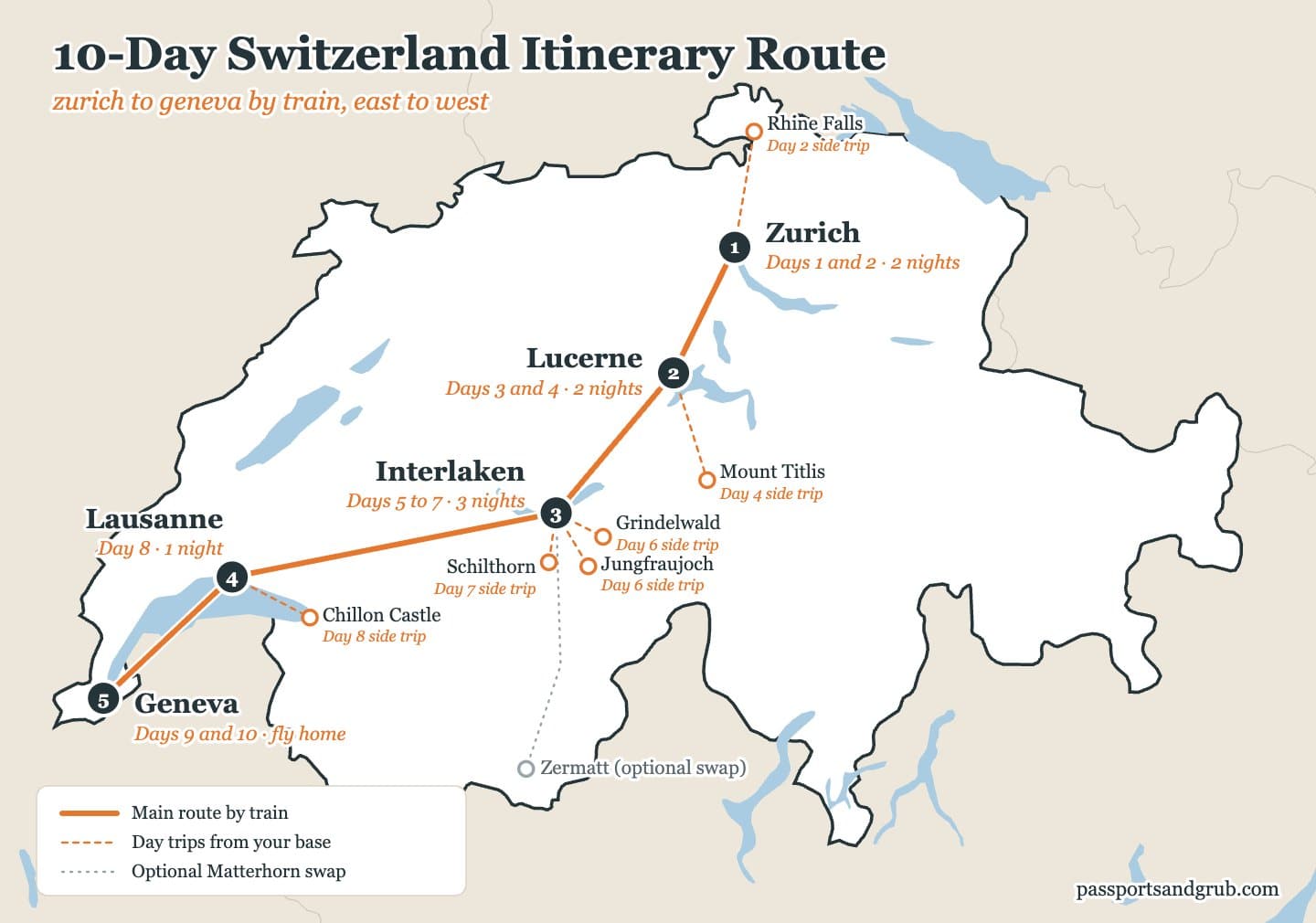
Want to see the Matterhorn? Swap Day 8 in Lausanne for a night in Zermatt.
The train from Interlaken to Zermatt takes about 2 hours and 15 minutes, and Zermatt to Geneva takes about 3 hours and 45 minutes, so you can still end in Geneva on Day 9.
Before You Go: Timing, Costs, and Getting Around
When Is the Best Time to Visit Switzerland?
June through September is best for hiking, lake cruises, and clear mountain views. December through March is ski season, and the snow makes the Alps look like a postcard.
Late spring and November are cheaper, but many mountain lifts close for maintenance, so check before you book a mountain day.
How Much Does 10 Days in Switzerland Cost?
Switzerland is one of the most expensive countries in Europe, so plan for it. Your biggest costs are hotels, the 8-day Swiss Travel Pass (CHF 439, about $542, in second class), and one big mountain ticket like Jungfraujoch, which the pass only discounts.
What I paid for hotels: Hotel D in Geneva was about $240 a night, the Drei Berge Hotel in Mürren was about $200 a night, and the 7132 Hotel in Vals runs around $1,500 a night. You can do Switzerland on a mid-range hotel budget and save your splurge for one or two nights, which is exactly what I did with 7132.
Budget more for food than you think. A simple sit-down lunch can easily run CHF 25 to 35 per person, so grocery store picnics from Coop or Migros are a smart way to save on mountain days.
How to Get Around Switzerland
You do not need a car for this route. Swiss trains run on the hour or half hour between every stop here, and you can check times and platforms in the SBB Mobile app.
Pack light, because you will be carrying your bags on and off trains five times, up and down hills, and I’m telling you, dragging big suitcases is not it. If you overpack anyway, use the SBB luggage service to send your bags ahead from station to station or door to door, and travel with just a day bag.
Swiss Travel Pass or Half Fare Card? The Swiss Travel Pass is best for this route because you are moving almost every few days. If you plan to stay in one or two places and take only a few trains, the Swiss Half Fare Card, which cuts most tickets in half, can be cheaper.
Seat reservations: Regular Swiss trains do not need them, so just hop on. Scenic trains like the Glacier Express do require a paid seat reservation, even with the pass.
Is 10 Days in Switzerland Enough?
Yes, for a first trip. You will see the highlights without rushing, as long as you keep it to five bases. If you only have 7 days, cut Lausanne and one Interlaken day.
And please, do not try to see it all. Your itinerary does not have to be jam-packed. You need time to breathe and rest, and it is OK not to sightsee every single day. Use the slow options I built in, like the lake day on Day 4 and the easy arrival afternoon in Interlaken on Day 5, and give yourself permission to sit at a café, take a long lunch, or spend an afternoon at the spa. Switzerland will still be there tomorrow.
Switzerland Quick Facts
- ✈️ Airports: Zurich (ZRH) and Geneva (GVA). Fly into Zurich and out of Geneva for this route.
- 💰 Currency: Swiss franc (CHF). Cards are accepted almost everywhere.
- 🗣 Language: German, French, Italian, and Romansh. English is widely spoken in tourist areas. Learn a few phrases before you go.
- 🎫 Visa: Americans can visit Switzerland for up to 90 days in any 180-day period without a visa. Since April 10, 2026, the EU Entry/Exit System takes your fingerprints and photo at your first Schengen border.
- 🔌 Electricity: Switzerland uses Type J outlets, and many also fit the two-prong Type C plug. U.S. plugs will not fit, so bring a universal travel adapter.
- 📲 Phone service: Switzerland is not in the EU, so many U.S. international plans charge extra here. Check your plan or buy a Swiss eSIM before you fly.
- 🚙 Car Rentals: The Switzerland rental car process can be daunting, and many people are apprehensive about driving in a foreign country. I get it!
Traveling soon? My trusted travel partners
Curated by Passports & Grub by Tomiko Harvey: the booking sites I use on my own trips.
Some of these are affiliate links, which means I may earn a small commission at no extra cost to you. I only recommend services I use and trust.
Days 1 and 2: Zurich and Rhine Falls
Day 1: Arrive and Walk the Old Town
Getting there: Zurich Airport to the city center takes about 10 minutes by train. On Day 2, Rhine Falls is about 1 hour from Zurich.
Zurich Card tip: Your Swiss Travel Pass starts on Day 3, so buy a 48-hour Zurich Card for your first two days.
It covers trams, buses, and boats in the city, including the airport train, plus free or discounted entry to many museums. The Rhine Falls trip is outside the city zone, so buy that train ticket separately.
Zurich is Switzerland’s largest city and the easiest place to land. Keep Day 1 light, because you will be jet-lagged, and the best of Zurich is walkable.
Make your way to the Old Town (Altstadt), where winding cobblestone streets lead you through a medieval marvel that houses some of Zurich’s most significant historical landmarks.
The Grossmünster, an iconic twin-towered church, is a must-visit for its architectural beauty and panoramic views from its towers.
Nearby, the Fraumünster Church, known for its stained glass windows designed by Marc Chagall, offers a peaceful retreat into spirituality and art.
Walk Bahnhofstrasse, one of the most famous shopping streets in the world, and stop at Confiserie Sprüngli on Paradeplatz for a box of Luxemburgerli, its small, airy macarons.
End the afternoon at Lindenhof, a free hilltop park with views over the Limmat River and the Old Town, then cross to the Niederdorf, the lively old-town lane on the east bank, for dinner.
Cards are accepted almost everywhere in Switzerland, but carry a few Swiss francs for small cafes, markets, and mountain huts.
For a classic Swiss dinner, book a table at Zeughauskeller, a beer hall inside a 15th-century armory known for sausages, rösti, and big portions.
Day 2: Rhine Falls and the Swiss National Museum
Start Day 2 with a morning trip to the nearby UNESCO World Heritage Site of Rhine Falls, Europe’s largest waterfall.
Located just under an hour from Zurich by train, it’s an easy and memorable addition to your itinerary.
The boat ride to the rock in the middle of the falls is exhilarating and provides the best views and photo opportunities.
Back in Zurich, spend the afternoon at the Swiss National Museum, the castle-like building right next to the main station, or take a Lake Zurich boat cruise from Bürkliplatz.
If you still have energy, take the train up Uetliberg, Zurich’s own mountain, for sunset views over the city, the lake, and the Alps.
You can ride to the top and walk the ridge, or book a guided bike tour if you want to work for the view.

Where to stay in Zurich: Stay near the main station or in the Old Town so you can walk everywhere. For luxury, look at Baur au Lac on the lake or Storchen on the river in the Old Town.
Day 3: Lucerne, Chapel Bridge, and Mount Pilatus or Rigi
Getting there: Zurich to Lucerne, about 45 minutes by train.
On Day 3, take an early train to Lucerne so you have the whole day. Drop your bags at your hotel, and spend the morning in the medieval Old Town before heading up a mountain in the afternoon.
Lucerne sits right on Lake Lucerne with mountains on every side, and the Old Town is small enough to cover on foot in a morning.
Your exploration should begin with the iconic Kapellbrücke (Chapel Bridge), the oldest wooden covered bridge in Europe, adorned with paintings that tell tales of Lucerne’s history.
A short walk away is the Water Tower, which has served as a prison and a treasury vault over the centuries.
Walk a few minutes downriver to Spreuer Bridge, a quieter covered bridge with its own painted panels, then climb the Musegg Wall, the old city wall, for a free view over the rooftops.
Next, venture to the Lion Monument, a poignant sculpture carved into rock commemorating Swiss Guards who were massacred during the French Revolution.
This moving piece of art is a testament to the bravery and loyalty of the Swiss people.
Pick one mountain for the afternoon. In season, do Mount Pilatus as the Golden Round Trip: take the boat from Lucerne to Alpnachstad, ride the steepest cogwheel railway in the world to the top, then take the aerial cableway and gondola down to Kriens and the bus back to town.
Plan on about 4 to 6 hours. The cogwheel railway only runs from about May to November, so in winter, ride the gondola up and down from Kriens.
If you would rather save money, take the boat to Vitznau and ride Europe’s oldest mountain railway up Mount Rigi.
The boat and the train are both free with the Swiss Travel Pass, while Pilatus only gets you a discount. Either way, go on a clear day.
If the peaks are in the clouds, save the mountain for tomorrow and do the lake cruise instead.
For a rainy-day option, visit the Swiss Transport Museum, which gives insights into the country’s history of mobility and communication.
As the day winds down, take a leisurely boat ride on Lake Lucerne, an ideal way to absorb the area’s scenic beauty in a relaxed setting.
What to eat in Lucerne: Order Luzerner Chügelipastete, the city’s signature dish, a puff pastry shell filled with veal and mushrooms in a cream sauce. It is rich, so share it if you are saving room for chocolate.
Where to stay in Lucerne: For luxury, look at the Hotel Schweizerhof on the lakefront or Hotel des Balances right on the river in the Old Town.
Stay within walking distance of the train station and boat docks, because you will use both.

Day 4: Mount Titlis Day Trip or a Slow Day in Lucerne
Getting there: Lucerne to Engelberg, about 45 minutes by train, then gondolas to the summit.
First, decide if you need Titlis. Titlis and Jungfraujoch (Day 6) are both high glacier mountains with snow, ice, and big views, and both are expensive.
Most people only need one. Pick Titlis if you want a cheaper half-day snow trip from Lucerne. Pick Jungfraujoch if you want the Top of Europe and can only do one big mountain.
If you go, catch an early train to Engelberg.
From the village, the Titlis Xpress gondola takes you up to Trübsee and Stand, then the Titlis Rotair, the world’s first revolving cable car, turns a full circle on the way to the summit.
The ride up takes about 45 minutes.
At the top, nearly 10,000 feet above sea level, you can explore the glacier cave and walk the Titlis Cliff Walk, one of the highest suspension bridges in Europe.
In summer, the Ice Flyer chairlift glides over the glacier and the Glacier Park is open for snow tubing and sledding.
Leave early and you will be back in Lucerne by 2 or 3 p.m., so Day 4 is really a half day. On the way down, get off at Trübsee for a walk around the lake.
The Swiss Travel Pass covers the train to Engelberg and gets you a discount on the cable cars, so budget for the lift ticket.
If you want it all planned, book a guided Mount Titlis day trip from Lucerne.
What to wear: The summit is often near or below 32°F, even in summer. Bring layers, gloves, sunglasses, and sunscreen, because the glacier reflects the sun.
Before you book: Titlis closes for a few days of maintenance, usually in November, and some rides only run in summer, so check the schedule for your dates.
Doing Jungfraujoch instead? Use Day 4 for the Lucerne mountain you skipped on Day 3, a slow Lake Lucerne boat cruise, or the Swiss Museum of Transport. Your feet will thank you before three days in the Alps.
Day 5: Interlaken, Harder Kulm, and the Lakes
Getting there: Lucerne to Interlaken, about 2 hours by train.
I explored Interlaken on my trip, and it works best as your base, not your destination. Check in, drop your bags, and keep this afternoon easy, because tomorrow is your big mountain day.
Ride the Harder Kulm funicular, about 10 minutes from town, for the classic view of Interlaken between its two lakes with the Eiger, Mönch, and Jungfrau behind it. Go late in the day for the best light.
Or take a boat across Lake Brienz to the Giessbach Falls, a waterfall that drops right down to the lake. Lake boats are free with the Swiss Travel Pass.
Back in town, watch the paragliders land in Höhematte, the big park in the center of Interlaken, or book a tandem paragliding flight if you want to be one of them.
Where to stay in Interlaken: For luxury, the Victoria Jungfrau Grand Hotel and Spa is the classic. Wherever you book, stay near Interlaken Ost station, where the trains leave for Grindelwald and Lauterbrunnen.

Days 6 and 7: Jungfraujoch, Grindelwald, Mürren, and Schilthorn
Getting there: Interlaken Ost to Grindelwald Terminal, about 30 minutes. Interlaken to Lauterbrunnen, about 20 minutes, then about 25 minutes by cable car and train up to Mürren.
Day 6: Jungfraujoch, Top of Europe, or Grindelwald First
If you skipped Titlis on Day 4, today is your big mountain.
The fastest way up is the train from Interlaken Ost to Grindelwald Terminal, the Eiger Express gondola to Eigergletscher, and then the Jungfrau Railway, which runs through tunnels inside the Eiger and Mönch to the top.
Plan on about 1.5 to 2 hours each way. For the classic loop, go up that way and come back down through Kleine Scheidegg, Wengen, and Lauterbrunnen.
At over 11,000 feet, Jungfraujoch is the highest railway station in Europe.
Step out on the Sphinx terrace for the view down the Aletsch Glacier, the longest glacier in the Alps, walk through the Ice Palace, and stand in the snow on the Plateau.
There is even a Lindt chocolate shop at the top.
Before you buy: This is one of the most expensive tickets in Switzerland, and the Swiss Travel Pass only takes about 25 percent off.
Check the Jungfraujoch webcam the morning you go, because if the summit is inside a cloud, you will pay all that money to look at white.
Reserve your Jungfrau Railway seats in summer.
At this altitude, move slowly and drink water, because some people feel lightheaded. If you want it all handled, book a Jungfraujoch day trip.
If the price stings, Schilthorn on Day 7 gives you a summit for far less.
Did Titlis instead? Spend Day 6 in Grindelwald, a mountain village with the Eiger right above it, and ride the gondola up to First.
Ride the gondola from Grindelwald up to First, about 25 minutes, and walk the First Cliff Walk, a metal walkway bolted to the side of the mountain with a viewing platform over the drop.
Come down the fun way on the First Flyer zip line or the First Glider, or rent a mountain cart or Trottibike for part of the ride down.
If you would rather walk, hike about an hour each way to Bachalpsee, a mountain lake with the peaks reflected in it. Plan on a half day to a full day, depending on how much you add.
Day 7: Lauterbrunnen, Mürren, Gimmelwald, and Schilthorn
How to fit it all in: Day 7 is the one day on this trip that can get overloaded, so keep it simple. Go up Schilthorn first thing while the sky is clear, walk or ride down to Gimmelwald for lunch, and spend the afternoon in Mürren.
In summer, add Trümmelbach Falls on your way back through the valley. If you are taking a ski lesson, give it its own morning and save Schilthorn for the afternoon or skip it.
Down in the Lauterbrunnen Valley, there are 72 waterfalls, including Trümmelbach Falls, a series of glacier waterfalls inside the mountain that you reach by a tunnel elevator. Trümmelbach is only open from spring to fall.
The valley is also the gateway to Mürren, a car-free village with quiet walking paths and Swiss restaurants with a view. It made my list of the most beautiful villages in Switzerland.
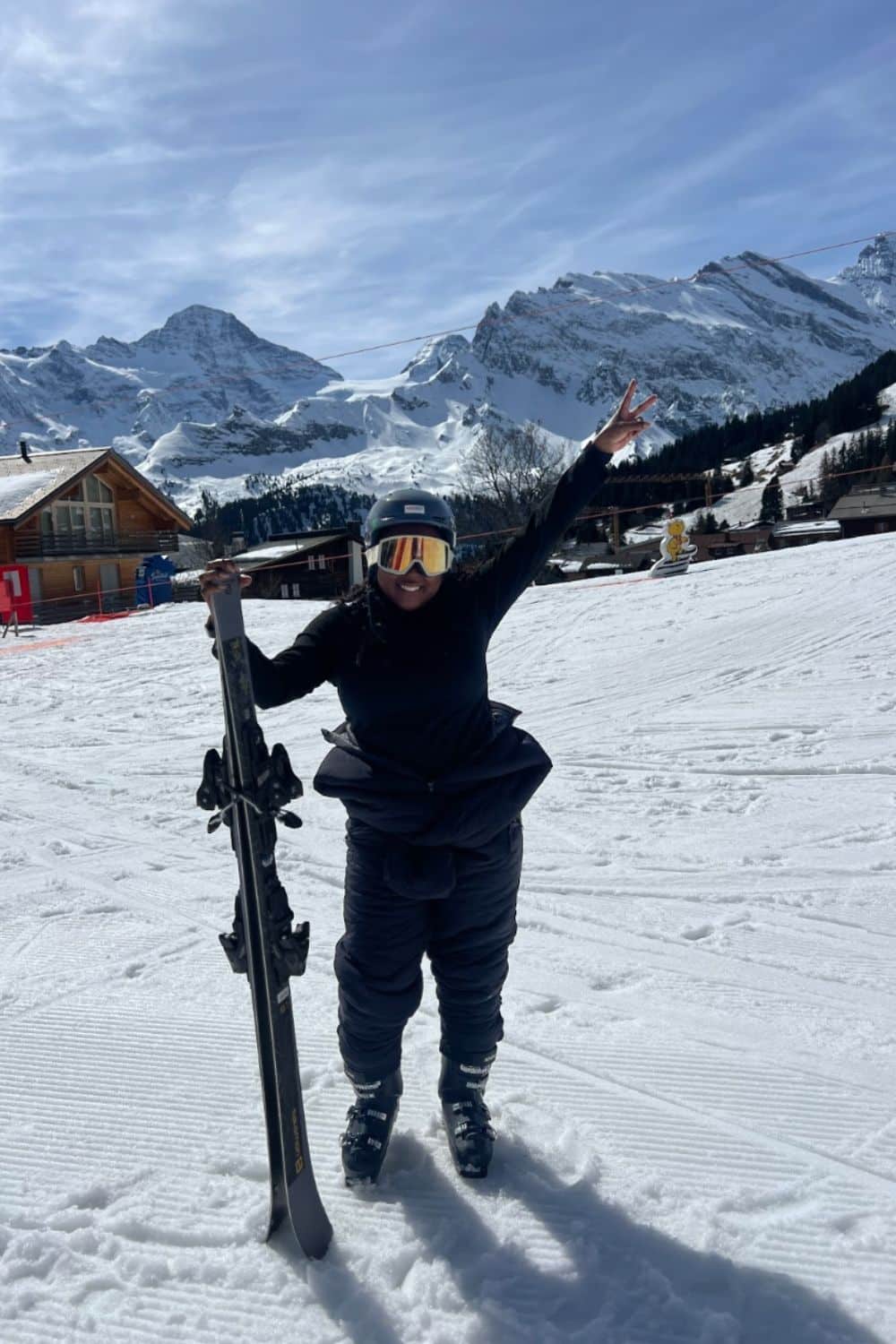
This is the part of Switzerland I know best. I stayed at the Drei Berge Hotel in Mürren and took my ski lessons there.
The photos on the Drei Berge website do not do it justice. Based on them, I was a little nervous, but it turned out to be one of the cutest hotels I have stayed in, with old-school music playing and themed rooms.
It was my second-favorite hotel of the whole trip, right behind 7132. Rooms ran about $200 a night. Heads up: Drei Berge is closed for renovations until December 2026, so check that it has reopened before you book.

It was only my second time skiing, and it was hard. You need more upper body strength than you think, because once you fall, getting yourself back up on a slope is a workout of its own.
But it was fun, and my instructor was amazing. If you are a beginner, book a lesson instead of trying to teach yourself.
From Mürren, it is a short ride or walk down to Gimmelwald, a tiny farming village with little more than chalets, cows, and one of the best views in the valley. It is quiet in the best way.
Then go up to Schilthorn. The revolving Piz Gloria restaurant at the summit was a filming location for the 1969 James Bond movie On Her Majesty’s Secret Service, and there is a Bond World exhibit at the top.
On a clear day, you can see more than 200 peaks. Book a Schilthorn trip or buy the cable car ticket in Mürren, since the Swiss Travel Pass gets you a discount.
Where to stay: Mürren puts you closer to Schilthorn and away from the Interlaken crowds. I stayed at Drei Berge, and Hotel Alpenruh, which I also visited, sits right by the Schilthorn cable car.
Both are small, so book early for ski season. If you do not mind moving once, spend your last night here instead of Interlaken. You will wake up in the mountains, and Day 8 is about 3 hours by train from Mürren to Lausanne.

Day 8: Lausanne, Lavaux Vineyards, and Chillon Castle
Getting there: Interlaken to Lausanne, about 2 hours by train.
Stop in Bern on the Way
The train from Interlaken to Lausanne runs through Bern, so break up the ride with a few hours in the Swiss capital. Leave your bags in a locker at Bern station and walk the arcaded Old Town to the Zytglogge clock tower.
While you are there, pick up Mandelbärli, the little almond bear cookies Bern is known for. I had them in Bern, and they make an easy gift to bring home.
On day 8, your adventure takes you to the vibrant city of Lausanne, beautifully positioned on the shores of Lake Geneva. Lausanne, the Olympic Capital, boasts an eclectic mix of historic charm and modern vitality.
Begin your exploration with a visit to the Olympic Museum. This museum offers an immersive experience of the history and spirit of the Olympics through interactive exhibits and a vast collection of memorabilia.
Next, wander through the cobblestone streets of Lausanne’s Old Town, where the impressive Lausanne Cathedral, one of the finest Gothic buildings in Switzerland, is waiting.
Be sure to climb the tower for panoramic views of the city, the lake, and the surrounding Alps.
Lausanne’s public transportation system, which is efficient and easy to navigate, will help you explore the city’s sights seamlessly.
In the afternoon, take a short boat ride from Lausanne to explore the vineyard terraces of Lavaux, a UNESCO World Heritage site.
The vineyards step down the hillside to the lake, and you can taste local wine right where it is made.
End the day along the Ouchy Promenade in Lausanne, with views across Lake Geneva to the French Alps.
The promenade is a great place to eat, with several restaurants offering dishes ranging from Swiss specialties like fondue to international cuisine.
If you have time, take the 20-minute train to Montreux to see Chillon Castle, a medieval castle on a rock in Lake Geneva. It is one of the most visited historic sites in Switzerland.

Day 9: Geneva
Getting there: Lausanne to Geneva, about 40 minutes by train.
On Day 9, spend the day in Geneva, an international city between the Alps and the Jura mountains on the shore of Lake Geneva.
Geneva is where I based myself on the French-speaking side. I stayed at Hotel D, which was about $240 a night, booked a Geneva walking tour to get my bearings, and spent an afternoon at the International Red Cross and Red Crescent Museum.
Start at the Jet d’Eau, the city’s famous fountain, which shoots water about 460 feet into the air.
A morning walk along the lakefront promenade is the easiest way to start the day.
Next, head into the city’s Old Town to discover the treasures of Geneva’s history and culture.
Wander through the narrow streets to find Place du Bourg-de-Four, a square filled with cafes and the perfect spot to experience the local ambiance.
Don’t miss St. Pierre Cathedral; if you’re feeling adventurous, climb the North Tower for panoramic views of the city. Geneva is also home to numerous international organizations.
While the United Nations’ European headquarters can be challenging to visit without prior arrangements, the area around it, including the Broken Chair sculpture, is accessible and offers a moment of reflection on international diplomacy and peace efforts.
If you have time for more, one of Geneva’s many museums. The Museum of Natural History is an excellent choice for families, while art lovers will appreciate the Museum of Art and History.
For a unique experience, visit the Patek Philippe Museum to marvel at the artistry of watchmaking, a field in which Switzerland excels.
Wrap up a full day in the trendy district of Carouge, likened to a small bohemian village, where you can browse artisan shops and savor dinner in one of its inviting cafes or restaurants.
With its Mediterranean-style architecture, this area contrasts Geneva’s international and diplomatic character. It has a relaxed atmosphere to reflect on your Swiss adventures.
Where I ate: I had dinner at Le Chalet, and one night we went to Zanzibar, an African restaurant and lounge in Geneva. It is a nice change of pace from fondue and rösti.

Day 10: Fly Home From Geneva or Extend Your Stay
Getting there: Geneva’s main station to Geneva Airport, about 7 minutes by train.
As your 10-day journey through Switzerland ends, you’ve got a big decision to make. Do you want to say goodbye to this beautiful country or extend your adventure to explore even more? I would not leave Switzerland without riding on the Glacier Express.
Geneva Airport is about 7 minutes from the main train station, so flying home from Geneva saves you the 3-hour ride back to Zurich. Book your flights into Zurich and out of Geneva.
If you feel like extending your stay, consider visiting a destination you might have missed.
The city of Basel, with its art museums and Rhine River setting, offers a blend of culture and history.
The Valais region, with its mountains and vineyards, is also a great place for hiking, wine tasting, and embracing the slower pace of Swiss life.
Add the Glacier Express to Your Trip
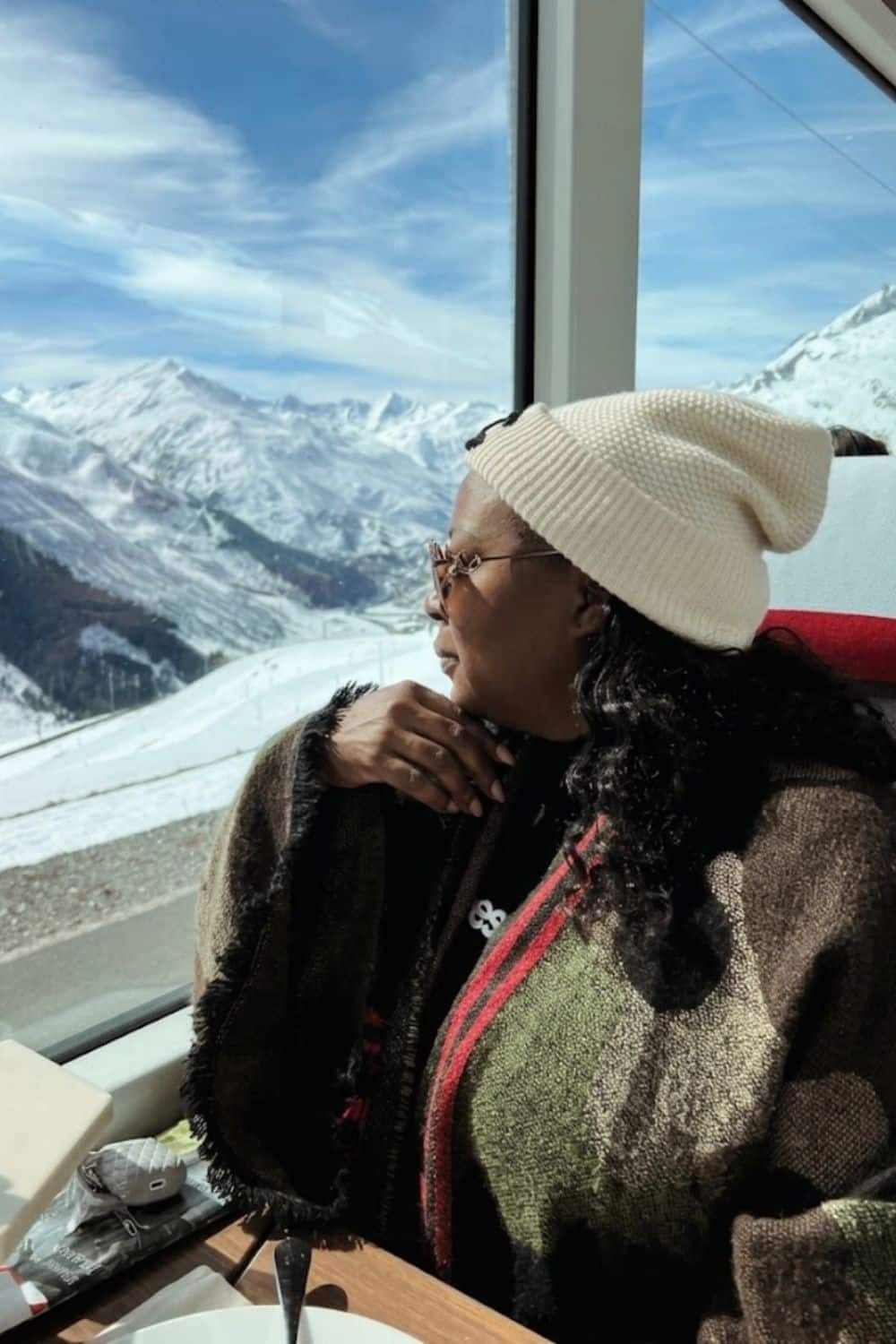
If you love train travel, add the Glacier Express. It is the best way to see the high Alps without hiking or driving, and it was a highlight of my trip.
There were five of us, and we rode the Glacier Express from Zermatt to Vals to stay at the 7132 Hotel. Eight hours, 291 bridges, and 91 tunnels later, I understood why it is called the slowest express train in the world. It was so peaceful.
We booked First Class instead of Excellence Class, and it was the right call for us. First Class was comfortable, our tickets came with meals and champagne, and I was even able to get some work done in between staring out the window. Excellence Class adds a lounge-style setup and a multi-course meal with drinks, so it is worth it if you want the train itself to be the splurge. Check exactly what your ticket includes when you book.
The Glacier Express connects Zermatt and St. Moritz, running straight through the Swiss Alps.
Along the way, you pass snow-covered peaks, alpine meadows, deep gorges, and forests.
The panoramic windows stretch almost from floor to ceiling, so you can see everything from your seat.
The train crosses the Oberalp Pass, the highest point of the trip at about 6,670 feet, and runs over hundreds of bridges and through dozens of tunnels, including the famous Landwasser Viaduct, a six-arch bridge about 213 feet high that runs straight into a tunnel in the cliff.
How to fit it in: Add two days after Day 7. Take the train from Interlaken to Zermatt, ride the Glacier Express to St. Moritz, then take the train to Zurich and fly home from there.
Glacier Express Tickets, Prices, and Booking
You need two things to board: a valid train ticket or travel pass, and a separate seat reservation. The Swiss Travel Pass, Swiss Half Fare Card, GA travelcard, Eurail, and Interrail passes all count for the base ticket, so with your Swiss Travel Pass, you only pay for the seat reservation.
| Class (one way) | Base Ticket | Seat Reservation | Total |
|---|---|---|---|
| 2nd Class | Up to CHF 159 to 166 | CHF 54 | About CHF 213 to 220 |
| 1st Class | Up to CHF 272 | CHF 54 | About CHF 326 |
| Excellence Class | CHF 272 | CHF 540 to 590, with a 5-course gourmet menu | About CHF 812 |
When to book: Base tickets go on sale up to 180 days before you travel. Seat reservations for 1st and 2nd Class open 93 days before your travel date, and Excellence Class reservations open in October for the full season ahead. I booked our seats online a few weeks before the trip, and I am glad I did, because the best seats go fast. Set a reminder for 93 days out if you have your heart set on a specific date.
End in Vals at the 7132 Hotel. My Glacier Express ride ended in Vals, and the 7132 Hotel was my number one hotel in Switzerland.
It is the epitome of luxury: the rooms overlook the village with mountain views, there is a tub in the middle of the bathroom, and the large walk-in shower is to die for. Expect to pay around $1,500 a night.
The spa is the reason to stay here. It is built around the Therme Vals thermal baths, and the clientele is so upscale that phones and photos are not allowed in the spa area, which is why you will not see pictures of it here.
Plan your trip so you have at least one full day to enjoy it.
Do You Need Travel Insurance for Switzerland?
Yes. Switzerland has excellent medical care, but it is expensive, and U.S. health insurance usually does not cover you abroad. I never travel without travel insurance.
Ski falls, a twisted ankle on a hiking trail, a missed connection, or a lost bag can all turn into real money fast.
Mountain weather can also cancel excursions and delay trains, so choose a policy that covers trip interruptions, and if you plan to ski, make sure winter sports are included.
My safety checklist: Before every trip, I go through my Comprehensive Travel Safety Guide, the same no-nonsense guide I wrote for women who travel. It covers the habits, checks, and tools I use to stay alert without living on edge, and it is $19.99.
What I Would Tell My Girlfriends Before 10 Days in Switzerland
If you only remember three things from this guide: fly into Zurich and out of Geneva, buy the 8-day Swiss Travel Pass, and pick one big mountain instead of trying to do them all.
Leave room for a cloudy day, because you do not want to pay for a summit you cannot see.
Then give yourself a few nights you will never forget. For me, that was the 7132 Hotel in Vals, my number one stay in Switzerland, with Drei Berge in Mürren a close second.
Mürren is where I took my ski lessons, and even though getting back up after a fall was a workout, it was one of the most fun days of the trip. If you can, end the way I did, on the Glacier Express.
Switzerland is expensive, but it is also one of the easiest countries in Europe to travel. The trains run on time, everything is clean, and you can see more in ten days here than almost anywhere else.
Pack light, check the weather before every mountain day, and go. And if you want more ideas for your trip, start with my list of the most beautiful villages in Switzerland.
Keep Planning Your Switzerland Trip
My other Switzerland guides, from the train ride to the hotel I still talk about.

7132 Hotel in Vals Review
My favorite hotel in Switzerland, with mountain views, a tub in the middle of the bathroom, and a thermal spa so exclusive that phones are not allowed.
Read the guide →
Glacier Express Review
Eight hours, 291 bridges, and 91 tunnels through the Alps. How I booked our seats and what to know before you ride.
Read the guide →
The Most Beautiful Villages in Switzerland
The small towns worth adding to your route, from car-free mountain villages to lakeside towns you can reach by train.
Read the guide →Have a question about planning your Switzerland trip? Find me on Instagram and TikTok or watch my travel videos on YouTube.