Is Jordan Safe to Visit Right Now? (November 2026 Update)
Quick Answer: Is Jordan Safe to Visit Right Now?
Jordan is open to visitors, but right now it isn’t a “just book it” destination. As of November 10, 2026, the U.S. State Department rates Jordan Level 3: Reconsider Travel because of terrorism and regional armed conflict.
On October 23, an attack on a church in Karak killed seven people, and on November 7 the U.S. Embassy in Amman warned of threats from Iranian-backed Houthis and possible flight cancellations. I felt safe everywhere I went in Jordan, but my trip was before the 2026 conflict.
What I’d do if I were booking Jordan right now:
- Check the U.S. advisory and embassy alerts the week you fly
- Enroll in STEP so embassy alerts come straight to your phone
- Book refundable hotels and flexible flights
- Stick to Amman, Petra, Wadi Rum, Aqaba, and the Dead Sea, and stay away from the Syria and Iraq border areas
Sources: U.S. State Department Jordan advisory (updated October 23, 2026), U.S. Embassy Amman security alert (November 7, 2026), UK Foreign Office (updated October 27, 2026). Checked November 10, 2026.
Is Jordan safe? It’s the first question people ask when they see my photos from Petra and Wadi Rum, and the answer is more complicated than it used to be.
I spent 10 days in Jordan on a trip hosted by the Jordan Tourism Board, traveling with a group from Amman to Jerash, Petra, Wadi Rum, Aqaba, and the Dead Sea.
I felt safe and welcome the entire time. That trip was before the 2026 conflict, though, so in this guide I separate what I experienced on the ground from what the U.S. and UK governments are saying right now.
Here’s where things stand as of November 2026, which areas to avoid, what to do if you’re already there, and the safety and dress tips I used as a Black woman traveling in Jordan.
What’s Happening in Jordan Right Now
The U.S. State Department moved Jordan to Level 3: Reconsider Travel in March 2026, after the war involving the U.S., Israel, and Iran began.
The links in this post may be affiliate links. That means that if you click them and make a purchase, this site makes a commission. It will have no impact on the price you pay or the experience of your purchase.
During that fighting, Jordan’s army reported that 281 Iranian missiles and drones were fired at the country before the April ceasefire, and most were intercepted.
The advisory was updated again on October 23, 2026, with no change to the level. The update added threats from Iranian-backed Houthis and Iranian efforts to target U.S. officials.
The same day, an attack on a Greek Orthodox church in Karak killed seven people and injured 27, according to Jordanian police.
Karak Castle is a stop on some King’s Highway routes, so if it’s on your itinerary, check the latest alerts before you go.
On November 7, the U.S. Embassy in Amman issued a security alert asking Americans to stay vigilant, avoid demonstrations, and expect possible flight cancellations, airspace closures, and travel disruptions.
The embassy remains open for routine services.
Regional airspace can still close with little notice, so book flexible fares and confirm your flight with the airline the day before you fly.
Travel Insurance You Shouldn’t Skip
Flights change. Bags get lost. Medical care abroad is expensive. Travel insurance is the one booking I never skip because it protects both your trip and your money when things don’t go as planned.
On-the-Ground Safety in Jordan
Jordan generally has low levels of violent crime and a strong law enforcement presence.
The main tourist cities, including Amman, Petra, and Aqaba, have a visible police and tourist police presence.
Public spaces, historical sites, and well-travelled tourist areas are routinely patrolled and considered safe during the day.
If Jordan’s been sitting on your bucket list, don’t miss my detailed guides to help you map out the perfect trip:
👉🏾 Jordan Itinerary (5, 7, or 10 Days), with the exact route I took and where I stayed
Whether you’re headed to Petra, Wadi Rum, or floating in the Dead Sea, I’ve done the legwork so you can travel stress-free.
If you are visiting Petra for the first time, having a knowledgeable guide changes everything. You move beyond just taking photos and actually understand the history, architecture, and hidden corners most visitors miss.
- Ideal for first time visitors
- Professional guide included
- Efficient routing to avoid peak congestion
- Flexible cancellation options
Where is Jordan Located
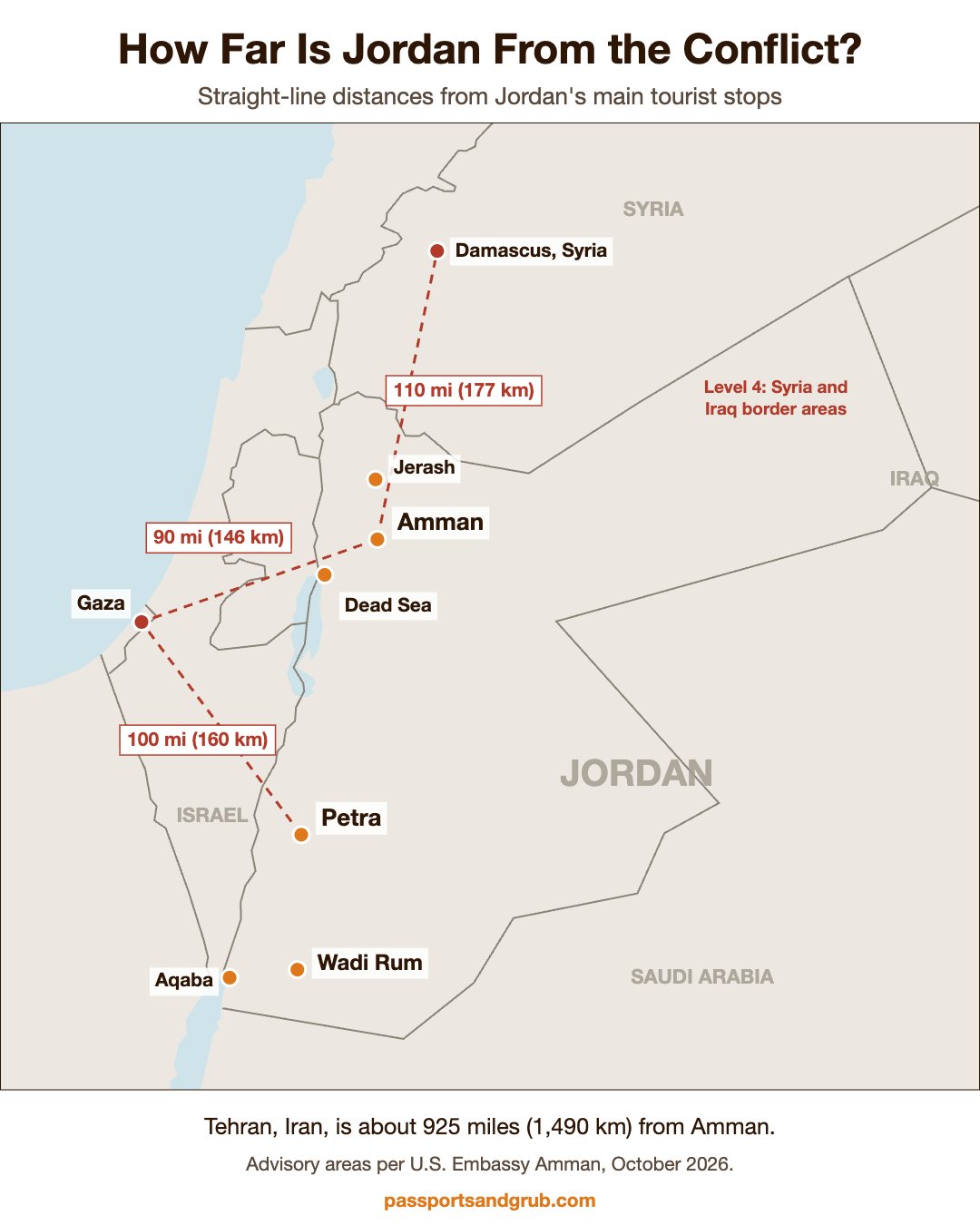
Jordan is in the Middle East, sitting right between Israel, Saudi Arabia, Iraq, and Syria. And yes, I know how that sounds if you’re just going off what the news shows.
But let’s keep it real: location alone doesn’t tell the whole story.
I’ve had folks look at me sideways when I say I went to Jordan, like I was stepping into chaos. But here’s the truth: for years, Jordan has been one of the most stable countries in the region, and that’s why it stayed open to tourists even through the 2026 conflict.
It does border Syria and Iraq, but the State Department’s Do Not Travel zones are along those borders, far from Petra, Wadi Rum, the Dead Sea, and central Amman.
My tour guide, Mahdi, put this in perspective better than any statistic could.
He asked me where I lived, and I said the U.S. He asked where in the U.S., and I said Tennessee. Then he asked where in Tennessee, and I told him Murfreesboro.
Then he asked me to name a major street in Murfreesboro. I said Memorial Boulevard.
He said, “So what if people told you not to visit the U.S. because there was a shootout in Tennessee, in Murfreesboro, on a street called Memorial?”
You see how crazy that sounds? Nobody cancels a trip to New York or Miami because of something that happened on one street in Murfreesboro.
But that’s what happens to Jordan every time there’s conflict somewhere in the region.
That’s one area. Jordan is an entire country. You’re not going to stumble into a war zone just because you’re flying into Amman or heading to Petra.
The government takes tourism seriously; there’s security at hotels, extra police around major attractions, and a strong focus on making visitors feel safe.
When I was there, I didn’t feel unsafe for a second.
So yes, Jordan is close to places with unrest, but that doesn’t mean it is unsafe.
If you skip it only because of where it sits on a map, you’re going to miss out on one of the most beautiful, historic, and welcoming places you’ll ever visit.
Just as I’ve written about safety in places like Mexico, Italy, South Africa, and Costa Rica, Jordan deserves more nuance than the headlines give it.
What the U.S. and UK Governments Say
The U.S. State Department rates Jordan Level 3: Reconsider Travel due to terrorism and armed conflict. U.S. government employees now need special authorization to travel to Jordan.
The advisory lists these areas:
- Do Not Travel: the Syria and Iraq border areas, including Ruwayshid and Mansheyat al Ghayyath; Syrian refugee camps; the city of Rusayfah; and the Baqa’a neighborhood of Ayn Basha.
- Higher risk: Zarqa City, and Ma’an City and parts of Ma’an Governorate. U.S. government staff can only travel there in daylight.
None of these places are on a typical Jordan itinerary. Amman, Jerash, Madaba, Petra, Wadi Rum, Aqaba, and the Dead Sea are all outside the Do Not Travel zones.
The UK Foreign Office, updated October 27, 2026, advises against all travel within 3 km of the Syrian border and has no warnings against the rest of the country.
It does warn that airports and airspace in the region could close at short notice.
If you’re combining Jordan and Israel, there are three land crossings: the King Hussein (Allenby) Bridge near Amman, the Sheikh Hussein crossing in the north, and the Wadi Araba crossing between Aqaba and Eilat.
According to the Jordan Tourism Board, Jordan doesn’t issue visas at the King Hussein Bridge, so get yours in advance if you’re entering there.
The crossings can close at short notice when tensions flare, like the King Hussein Bridge did after a shooting there in September 2024, so confirm your crossing is open the week you travel, not just when you book.

Is It Safe for Americans to Travel to Jordan?
When I traveled to Jordan before the 2026 conflict, I felt safe the entire time. I walked around Amman, explored Petra, floated in the Dead Sea, and never once felt uneasy.
The people were welcoming, security was visible, and tourism felt steady and normal. That said, the regional situation has changed.
This does not erase my personal experience in Jordan, but it does mean travelers need to pay closer attention to regional tensions and how they could affect flights, airspace, and travel logistics right now.
There’s no ban on Americans traveling to Jordan, and private U.S. citizens don’t need special permission.
But the October 2026 advisory update specifically mentions Iranian efforts to target U.S. officials, so as an American, I’d keep a low profile, skip political conversations and demonstrations, and enroll in STEP before I land.
My First-Hand Perspective
We were 100 miles from the Gaza Strip during our trip, yet life in Jordan remained calm and unaffected.
While the media might paint a picture of a region in chaos, that’s not the reality for Jordan.
We visited the Jordan River, where Jesus was baptized. Israel is right across the river, and as you can see from the image below, there were tours on the Israeli side as well, with no signs of possible attacks or violent crime.
At the time, the country felt stable and secure despite its proximity to conflict areas. At no point during our travels did we see or hear anything that suggested unrest or danger.
The Jordanian people were warm and welcoming, eager to share their culture and make us feel at home.
Whether strolling through Amman’s streets, marveling at Petra’s ancient ruins, or gazing at the stars in Wadi Rum, we felt safe, secure, and supported.

What to Do If You’re Already in Jordan
If you’re in Jordan now, the U.S. Embassy’s advice is to stay alert, keep a low profile, and avoid demonstrations and large gatherings.
Enroll in STEP so embassy alerts come straight to your phone, and follow guidance from Jordan’s National Center for Security and Crisis Management.
Jordan uses emergency sirens, and if there’s an aerial attack, the embassy advises staying away from windows and glass doors.
Keep your phone charged, check in with someone at home every day, and confirm your flight before you head to the airport. If you’re in immediate danger, dial 911 for Jordanian police.
What Jordan Felt Like When I Visited
The current headlines are serious, and if you are traveling now, you should follow official guidance closely.
That said, my experience in Jordan before the conflict looked very different from what the news cycle reflects today.
When I visited, the country felt calm, organized, and welcoming. I moved through Amman, Petra, Wadi Rum, and the Dead Sea without feeling uneasy.
Security was present but not overwhelming, tourism was active, and daily life felt steady.
It is important to separate what is happening regionally right now from what many travelers, including me, have experienced on the ground in Jordan.
Hire a Personal Tour Guide
I highly recommend hiring a personal tour guide.
During my visit, I enjoyed exploring Jordan with Mahdi Hanini, a professional guide the Jordan Tourism Board recommended.
Mahdi knew Jordan’s history and culture inside and out, and he was friendly and easy to talk to.
He was proud of his country and went out of his way to make sure our trip ran smoothly.
He walked us through the ruins of Petra, guided us through the desert in Wadi Rum, and pointed us to the best local spots in Amman.
I suggest hiring a full-time guide like Mahdi. You can contact him directly via WhatsApp at +962 7 9585 9116 to plan your adventure.
Right now, a local guide is also one more person watching the news and adjusting your plans for you.

Safe Cities to Visit in Jordan
Even with the current advisory, certain cities that are popular tourist destinations stand out for their exceptional hospitality, historical significance, and well-established tourist infrastructure.
During my trip, I visited several cities where I felt completely secure and welcomed. Here are some of the safest cities you should consider adding to your itinerary:
Amman
As the capital city, Amman mixes Roman ruins with a modern café scene. I found exploring highly safe, even when venturing out at night to visit local cafes and markets.
The city is known for its friendly locals who are eager to help and share their culture.
Tourist areas like the Citadel, Roman Theater, and Rainbow Street have a visible security presence, making it comfortable for solo travelers.
Petra
Home to the iconic archaeological site and one of the New Seven Wonders of the World, Petra is a must-visit.
The city is well-equipped for tourism, with clear signage, guided tours, and helpful staff throughout the site.
I spent an entire day hiking through the ancient city and felt safe at every turn. The local Bedouin community is welcoming and accustomed to international visitors.
Wadi Rum
Known as the “Valley of the Moon,” Wadi Rum is a desert of red sand and sandstone mountains. Staying overnight in a Bedouin camp was one of the highlights of my trip.
The camps are well-organized, and the guides are professional and attentive. I joined a group for a jeep tour and a camel ride, and at all times, safety protocols were clearly followed.
Aqaba
Aqaba is Jordan’s only coastal city, located on the Red Sea, where you can enjoy water activities like snorkeling and diving.
The town has a laid-back atmosphere, and I felt safe exploring both the beachfront and downtown areas.
The coral reefs start close to shore, and the diving centers adhere to international safety standards.
Dead Sea Region
The Dead Sea area is famous for its mineral-rich waters and therapeutic mud. The resorts here are secure and offer a range of amenities for travelers.
I indulged in spa treatments and floated in the sea without any safety concerns. The staff at these resorts are attentive and prioritize guest well-being.
Madaba
Known as the “City of Mosaics,” Madaba is rich in history and art. The city is small, easy to navigate, and the locals are exceptionally friendly.
I visited St. George’s Church to see the famous mosaic map and wandered through the streets feeling entirely at ease.
Jerash
Jerash has some of the best-preserved Roman ruins outside of Italy.
The archaeological site is well-maintained, with plenty of guides and security personnel around.
The local community is welcoming, and I enjoyed authentic Jordanian meals at nearby restaurants without any safety concerns.
These cities are where most of Jordan’s tourism security is focused, and they cover everything most first-time visitors want to see.

Safety Tips for Solo Female Travelers
I researched everything from street safety to hotel security to understand if Jordan is safe for solo female travelers like me who want to explore without feeling on edge.
I’ve created a list of Jordan travel safety tips for women that will help you feel more prepared and confident while navigating the country.
- Stay in a reputable Hotel.
Choose luxury hotels with high ratings and good reviews. I stayed at the W Hotel in Amman, Mövenpick Resort in Petra, Bubble Luxotel in Wadi Rum, Kempinski Aqaba, and the Dead Sea Marriott Resort. - Be mindful of cultural norms.
Jordan is a conservative country, so interactions between men and women can be more formal. If someone becomes overly inquisitive, a friendly but firm attitude works well. - Transportation tips.
- Use licensed taxis or ride-hailing apps like Careem.
- If you’re using public transportation, sit near other women or families.
- Hire a driver for your entire trip, as I did.
- Traveling at night.
While I felt safe in most areas, it’s always best to avoid walking alone late at night, even though I did, and I encountered no issues from wandering around finding food to exploring the markets. - Health and emergency contacts.
Make a note of local emergency numbers and the nearest hospitals to your accommodations. While I didn’t encounter any issues, being prepared is always good.
What to Wear in Jordan as a Female Traveler
Jordan’s culture is deeply rooted in tradition, and modesty in dress is important.
While you don’t need to cover yourself from head to toe, dressing respectfully will help you feel comfortable and blend in.
Besides religious reasons, weather should be considered when planning your Jordan itinerary, as temperatures rise quite high in the Middle East.
I visited in late October and early November and it was hot AF! It’s why Jordan made my list of places that are hot in November.
I thought I was gonna die from heat exhaustion at one point so be prepared for the heat.
In general, women and men should cover up as much skin as possible when visiting Jordan.
Tourists shouldn’t feel compelled to wear thick, long garments during their stay, but lightweight clothing that isn’t too revealing is the best way to go.
Sandals are also permissible, but with all of the walking, especially in Petra, go for comfort and leave the fancy sneakers at home because my feet hurt so bad trying to wear my cute Adidas sneakers.
General Guidelines
- Cover your shoulders and knees.
- Avoid tight or revealing clothing.
- Bring a scarf that’s versatile and can be used to cover your head or shoulders when needed.
What to Wear in Specific Locations
- Cities (e.g., Amman):
Amman is more cosmopolitan, so you’ll see a mix of styles. I wore loose trousers or maxi skirts with short-sleeve tops and felt perfectly dressed. - Religious Sites:
At mosques, you’ll need to cover your arms, legs, and hair. Having a scarf handy is a quick solution. - Rural Areas or Villages:
In smaller towns, locals tend to dress more conservatively. Long skirts, pants, and tunics are ideal. - Tourist Sites (e.g., Petra, Wadi Rum):
Comfort is key. I recommend lightweight, breathable fabrics that offer coverage. In Petra, comfortable walking shoes are a must and I even go as far as saying orthopedic shoes the way my feet were hurting, and in Wadi Rum, a scarf can protect against the desert wind.
Seasonal Dressing
- Summer (May–September):
Temperatures can soar, so stick to light fabrics like cotton or linen. A wide-brimmed hat and sunglasses are lifesavers. - Winter (December–February):
The desert gets cold at night! Pack a warm jacket and layers for the evenings. - Spring and Fall:
These seasons bring mild weather, making them ideal for travel. A lightweight jacket or cardigan will suffice, but as I stated, I was there in late October and early November, and it was extremely hot.
Footwear Recommendations
- Comfortable sneakers or hiking boots for exploring Petra and Wadi Rum.
- Sandals for casual outings in the city.
Combining Safety and Dressing Tips: Practical Examples
Let me share a few outfits I wore during my trip:
- Exploring Amman: Loose trousers, a short-sleeve blouse, and flats.
- Visiting Petra: Lightweight long-sleeve shirt, breathable hiking pants, and sneakers.
- Desert Safari in Wadi Rum: Cotton pants, a long-sleeve top, and a scarf for protection against sand.
These outfits kept me comfortable, helped me blend in, and made me feel more connected to the local culture.

Do You Need Travel Insurance for Jordan?
YES! Travel Insurance is essential no matter where you are traveling because accidents happen, and you should always travel with insurance.
I got extremely sick in the Czech Republic the one time I skipped travel insurance. I racked up thousands of dollars in medical bills, and the hospital wanted payment before the ER doctors would even see me.
For Jordan right now, look for a policy that covers trip cancellation, trip interruption, and medical evacuation, and read the fine print on war and terrorism exclusions.
Make sure to get your insurance before you head off on an adventure! I highly recommend Travelex Insurance.
Traveling to Jordan soon? My trusted travel partners
Curated by Passports & Grub by Tomiko Harvey: the booking sites I use on my own trips.
Some of these are affiliate links, which means I may earn a small commission at no extra cost to you. I only recommend services I use and trust.
Jordan Safety FAQ
Jordan’s main tourist areas are open, but as of November 2026 the U.S. State Department rates Jordan Level 3: Reconsider Travel because of terrorism and regional conflict. If you go, book refundable, enroll in STEP, and check embassy alerts the week you fly.
Level 3: Reconsider Travel. The State Department raised Jordan to Level 3 in March 2026 and kept it there in its October 23, 2026 update. The UK advises against travel only within 3 km of the Syrian border.
Petra is outside the State Department’s Do Not Travel zones, and I felt safe at every turn when I hiked it. Check current alerts before you go. If you’re driving the King’s Highway, Karak, a stop on some routes, was the site of an attack on October 23, 2026.
The U.S. Embassy in Amman warned on November 7, 2026, that flight cancellations, airspace closures, and travel disruptions are possible. Book flexible fares and confirm your flight with the airline the day before you fly.
In my experience, yes. I traveled with a group but also explored on my own, including walking around Amman at night, and I never had a problem. Dress modestly, use licensed taxis or Careem, and stay in well-reviewed hotels. My trip was before the 2026 conflict, so weigh the current advisory too.
The State Department says not to travel to the Syria and Iraq border areas, including Ruwayshid and Mansheyat al Ghayyath, Syrian refugee camps, Rusayfah, and the Baqa’a neighborhood of Ayn Basha. It lists Zarqa City and Ma’an as higher risk. None of these are on a typical tourist itinerary.
Usually not, unless your policy includes Cancel For Any Reason coverage. Many standard policies exclude war and terrorism, so read the exclusions before you buy, and look for trip cancellation, trip interruption, and medical evacuation coverage.
Why Jordan Still Belongs on Your Bucket List
If you’re still asking “Is Jordan safe?” here’s where I land. The tourist areas I visited are still open, but Jordan is a Level 3 destination right now, and that deserves your respect.
If you can stay flexible, book refundable, and keep up with embassy alerts, Jordan is still worth the trip. If you need a guaranteed, no-surprises vacation, wait for the advisory to come down.
Jordan is full of rich history, kind people, and bucket-list experiences, whether you’re floating in the Dead Sea, wandering through Petra, or stargazing in Wadi Rum.
And while the region’s geography raises eyebrows, my experience on the ground felt very different from the unrest you see on TV.
If you decide to go, go prepared. Pack your common sense, a scarf for modesty, and my Comprehensive Travel Safety Guide so you can focus on soaking up every moment without second-guessing yourself.
🧳 Want help planning? Read my 5, 7, or 10-Day Jordan Itinerary, with the exact route I took, where I stayed, and the tours I would book.
Got questions about safety, solo travel, or what to pack? Drop them in the comments. I got you.
And if this helped you feel more confident about visiting Jordan, share it with a friend who needs that same nudge.
I would love to hear your thoughts, so comment on Facebook, Threads, or Instagram.
Why not save this post to your Pinterest board for later? I am also on Pinterest, so feel free to follow Passports and Grub boards and get the latest PIN directly.